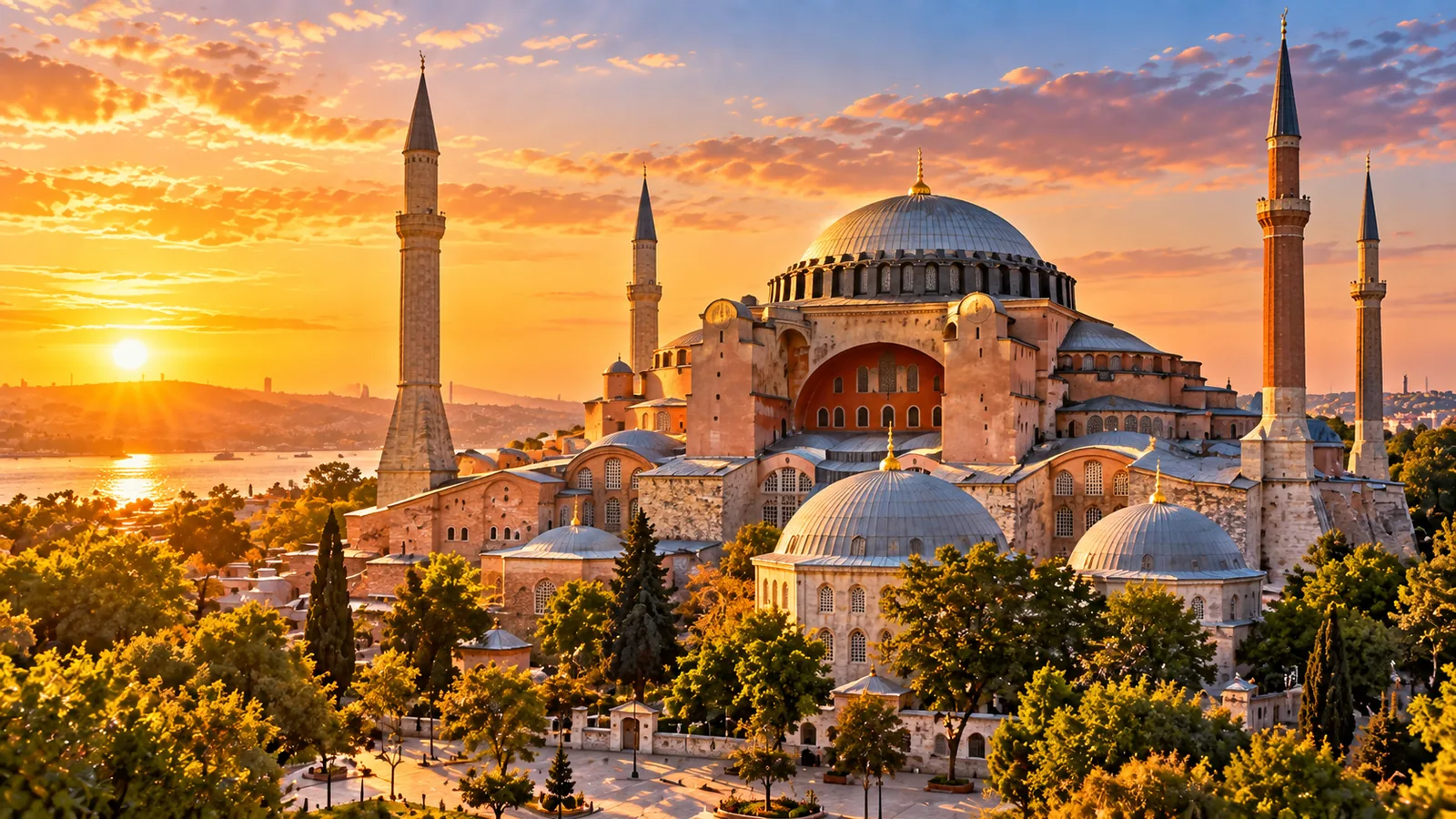
Hagia Sophia Visitor Guide
How to visit Istanbul’s sixth-century landmark and active mosque: what you can see, how tourist entry works, how long to allow, what to wear and which nearby sights fit naturally into the same day.
Hagia Sophia is not a normal museum visit.
It is both one of Istanbul’s most important historic buildings and an active mosque. The best plan is to understand the visitor route before you arrive, allow extra time for security, and treat Hagia Sophia as part of a wider Sultanahmet walking day.
The present building was constructed between 532 and 537 under Emperor Justinian I. Its huge dome became one of the defining works of Byzantine architecture and later influenced Ottoman mosque design across Istanbul.
After the Ottoman conquest of Constantinople in 1453, Hagia Sophia became a mosque. It became a museum in the twentieth century and returned to mosque use in 2020. Those layers are exactly what make the building so important today.
More than 1,400 years of Istanbul history in one building
Hagia Sophia is part of UNESCO’s Historic Areas of Istanbul and is one of the monuments that defines the historic peninsula skyline.
Built under Justinian I
Anthemius of Tralles and Isidore of Miletus designed the present Hagia Sophia, crowned by a vast central dome.
Converted to an Ottoman mosque
After the conquest of Constantinople, the building entered a new chapter and gained Ottoman religious and architectural additions.
Museum period
Hagia Sophia operated as a museum for decades, making its Byzantine and Ottoman layers accessible as a historic monument.
Active mosque
Hagia Sophia returned to mosque use while remaining a major international cultural and architectural landmark.
Four details worth slowing down for
The building is visually overwhelming. These are the details that help make sense of what you are seeing.
The central dome
The scale of the dome and the way it appears to float above the main space are central to Hagia Sophia’s architectural importance.
Mosaics
Surviving Byzantine mosaics are among the building’s most important artistic remains. Visibility can depend on the current visitor route and restoration work.
Calligraphy & mosque features
Large calligraphic roundels, the mihrab, minbar and minarets show how the building evolved during its centuries as an Ottoman mosque.
Upper-gallery perspective
The visitor route gives a higher viewpoint across the interior, helping you understand the building’s scale and layered decoration.
Tourist visits and worship access use different arrangements.
For foreign visitors making a cultural or touristic visit, the visitor-management system introduced in 2024 uses a separate, ticketed route through the upper gallery. Worship access is managed separately because Hagia Sophia is an active mosque.
Restoration work can temporarily change what is visible. Current entry hours, ticket rules and route details should always be checked again shortly before your visit.
Read the Ministry visitor-management notice →A practical Sultanahmet half-day
These sights sit close together, so walking between them is more efficient than repeatedly crossing Istanbul.
Hagia Sophia
Start with your highest-priority sight and leave enough buffer for security.
Blue Mosque or Basilica Cistern
Choose the mosque for another major religious monument, or the cistern for a completely different underground atmosphere.
Topkapi Palace or Hippodrome
Add Topkapi if you have several more hours; choose the Hippodrome if you want a lighter walking route.
You can visit independently. A guide helps most with context.
If your main goal is simply to see the architecture and mosaics, an independent visit with an audio guide can work well. A licensed guide adds more value when you want the Byzantine, Ottoman and modern history explained together.
Choose the booking style that matches your day
Prices and inclusions change. Always read the live product details before paying.
Hagia Sophia entry + audio guide
Useful when you want to enter on your own schedule, reduce ticket-line waiting and explore at your own pace.
Check current availabilityHagia Sophia + Blue Mosque guided tour
Better for first-time visitors who want the two major Sultanahmet mosques explained together, with an optional Basilica Cistern add-on on some products.
Compare guided optionWhat to see next without wasting travel time
Hagia Sophia sits inside Istanbul’s strongest concentration of first-time sights.
Blue Mosque
An active seventeenth-century mosque and the natural companion sight to Hagia Sophia.
Basilica Cistern
A cool, atmospheric underground contrast to the bright monumental spaces above ground.
Topkapi Palace
Add it when you have several hours and want Ottoman court history after Hagia Sophia.
Hippodrome
Easy to walk through between the Blue Mosque and Sultanahmet Square without needing another ticket.
Hagia Sophia planning questions
These answers are written for a cultural/tourist visit. Worship arrangements are separate.
Is Hagia Sophia still a mosque?
Yes. Hagia Sophia is an active mosque. Tourist and cultural visits use a managed visitor route separate from worship access.
Do tourists need a ticket?
Foreign visitors making a cultural or touristic visit use the ticketed visitor route. Check current official information before your date because arrangements can change.
Can I skip the security line?
No. Some tickets can reduce ticket-queue waiting, but security screening still applies and can be slow during busy periods.
What should I wear?
Dress modestly. Shoulders and knees should be covered, and women should be prepared to cover their hair.
How long should I allow?
About 60–90 minutes is a useful planning range for the visitor route, plus extra time for security.
What should I combine with Hagia Sophia?
The Blue Mosque, Basilica Cistern, Hippodrome and Topkapi Palace are all nearby. For most first-time visitors, Hagia Sophia + Blue Mosque + Basilica Cistern is a strong compact cluster.
Next attraction guides
Blue Mosque
Visitor rules, prayer times and what to notice inside.
Basilica Cistern
Columns, reflections, Medusa heads and practical entry planning.
Topkapi Palace
Courtyards, collections, Harem planning and how much time to allow.
Grand Bazaar
How to explore the market without treating it as one quick shopping stop.